How to Choose and Test a Professional Faraday Tent.
In today’s world, where every device strives to remain constantly connected and the radio spectrum is overloaded with signals, the concept of information security has gone far beyond firewalls and antivirus software. Digital hygiene and data protection now also require physical isolation. In cases where shielding a small device inside a Faraday cage is not enough, large-scale solutions come into play - shielding tents, also known as Faraday tents.
Why Radio-Signal Protection Has Become Critical
Just ten years ago, physically isolating equipment from radio waves was mainly the domain of military units and intelligence services. Today, it has become a practical requirement for corporate security teams, law enforcement agencies, digital forensic laboratories, and cybersecurity researchers.
Wireless Everywhere
Modern devices include Wi-Fi, Bluetooth, NFC, GPS, and cellular interfaces that may operate in the background.
Signal Intelligence
Compact interception tools and directional antennas make RF collection easier and more accessible.
Remote Data Wipe
In digital forensics, a seized device must be isolated to prevent remote commands or evidence destruction.
Commercial Secrecy
Secure negotiations, prototype development, and malware analysis require a controlled RF perimeter.
Under these conditions, a shielding tent becomes a reliable physical barrier that separates the protected internal environment from the external radio-frequency spectrum.
What Is a Shielding Tent?
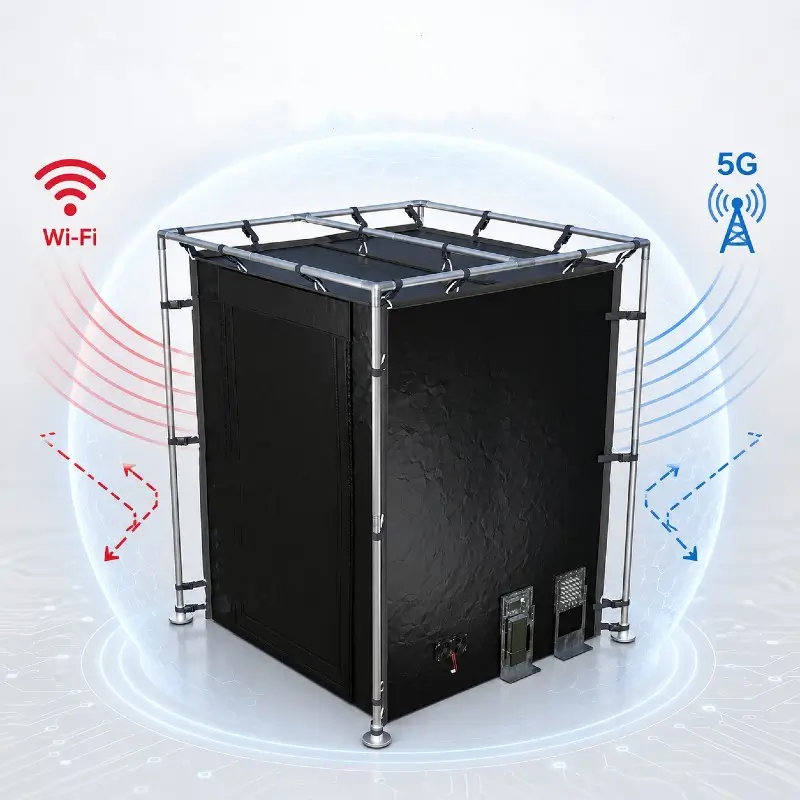
A shielding tent, or Faraday tent, is a mobile, rapidly deployable enclosure whose walls are made of advanced conductive materials. It works according to the principle of a Faraday cage: an external electromagnetic field causes electrons in the conductive material to redistribute, creating a compensating field that blocks external radio waves. In the same way, radio signals generated inside the tent cannot escape outside.
Aluminum-Frame Shielding Tents
For laboratories, secure rooms, production areas, and long-term deployments
Aluminum-frame tents are the traditional solution for controlled environments such as digital forensic laboratories, secure meeting rooms, and production facilities.
The frame supports multilayer shielding fabric and allows integration of heavier components, including lighting, filtered I/O panels, ventilation systems, and internal working equipment.
Inflatable Shielding Tents
For field operations, tactical teams, and mobile command posts
Inflatable shielding tents are designed for situations where deployment speed and mobility are critical. The frame is formed by pneumatic arches that can be inflated within minutes.
This configuration is especially useful for mobile forensic teams, military field units, temporary command posts, and emergency-response operations.
Which Threats Does a Faraday Tent Block?
A properly designed shielding tent provides strong attenuation across a wide frequency range and blocks multiple wireless attack vectors.
Wi-Fi and Bluetooth
Blocks 2.4 GHz, 5 GHz, and 6 GHz wireless communication, reducing risks from IoT compromise and man-in-the-middle attacks.
GSM, LTE, and 5G
Isolates mobile devices from base stations and prevents remote data transfer, microphone activation, or wipe commands.
GPS and GNSS
Prevents GPS, GLONASS, Galileo, and other navigation systems from receiving location data inside the protected perimeter.
RFID and NFC
Prevents remote reading of access cards, smart cards, contactless credentials, and biometric passports.
TEMPEST Leakage
Reduces electromagnetic emissions from servers, monitors, and other electronic equipment that could otherwise be intercepted.
Remote Exploitation
If a signal cannot physically reach a device, remote exploitation through wireless channels becomes impossible.
Main Elements of a Shielding Tent
The effectiveness of a shielding tent is determined not only by the fabric, but also by how every component is integrated. A weak point in any part of the system can create a signal leakage path.
Shielding Fabric
The primary RF barrier of the tent
The shielding fabric is the heart of the tent. High-quality solutions usually use multilayer textiles with conductive metal components integrated into the structure.
Nickel-coated copper is often used because it combines conductivity with better resistance to oxidation. The number of layers is critical for achieving professional attenuation levels.
Frame and Structure
Supports the fabric and integrated equipment
The frame must support both the weight of metallized fabric and additional internal systems such as lighting, ventilation, filters, and working equipment.
Aluminum joints or frame elements must not have sharp edges that could damage the conductive layer of the fabric.
Door and Entry System
The entry point must preserve electrical continuity
The door is historically the weakest part of any Faraday enclosure. A standard zipper is not sufficient because high-frequency signals may pass through small gaps.
Professional tents use overlapping shielding fabric, conductive closures, magnetic seals, or roll-down entry systems to maintain RF continuity.
Shielded Floor
Protects against signal leakage from below
The floor is exposed to mechanical stress from shoes, cases, racks, tables, and equipment legs. Damage to the floor is one of the most common causes of RF leakage.
Professional designs use a durable base layer, a shielding layer, and a protective top layer made of wear-resistant material.
Why Filters and Ventilation Are Essential
Any physical opening in a shielding tent is a potential antenna. Without specialized filters, cables and air ducts can become direct channels for signal penetration or data leakage.
Honeycomb Waveguide Vents
Airflow without RF leakage
Because the tent is sealed, people and equipment inside need ventilation and cooling. A simple hole with a fan would destroy the RF integrity of the enclosure.
A honeycomb waveguide vent allows airflow while attenuating electromagnetic waves. The cell geometry is calculated so that relevant radio frequencies cannot propagate through the opening.
EMI/RFI Filters and I/O Panels
Controlled connection points for electricity and communication
If an ordinary power cable passes through the wall of the tent, it can behave like an antenna. RF energy can couple onto the cable and radiate outside the protected perimeter.
Professional tents use EMI/RFI filters in rigid I/O panels. For data links, fiber optics are often preferred because glass or plastic fiber does not conduct electricity and cannot act as an antenna.
How Shielding Effectiveness Is Measured
Shielding performance is not measured by simply checking whether a mobile phone has signal. It is a physical value called shielding effectiveness, or SE, measured in decibels.
| Attenuation | Signal Reduction | Blocking Level | Typical Meaning |
|---|---|---|---|
| 10 dB | 10 times | 90% | Basic reduction |
| 30 dB | 1,000 times | 99.9% | Moderate shielding |
| 60 dB | 1,000,000 times | 99.9999% | Professional protection |
| 80–100 dB | Billions of times | High-grade | Government, defence, forensic, and high-security environments |
Frequency range is equally important. A tent may block 900 MHz GSM signals very well but perform poorly at 5 GHz or 6 GHz Wi-Fi frequencies. For this reason, professional specifications should state both attenuation and frequency range, for example: 85 dB from 10 MHz to 40 GHz.
Relevant Testing Standards
| Standard | Scope | Used For | Why It Matters |
|---|---|---|---|
| IEEE 299 | Shielding enclosures | Testing complete tents and rooms | Defines antenna placement, test frequencies, calibration, and measurement procedure. |
| ASTM D4935 | Flat materials | Testing shielding fabrics | Shows the potential of the material before it is assembled into a tent. |
| MIL-STD-188-125-2 | HEMP protection | Military and critical infrastructure | Defines protection requirements against high-altitude electromagnetic pulse effects. |
Why the Tent Must Be Tested After Assembly
Buying a high-quality shielding tent does not automatically guarantee protection. The tent must be checked after every assembly, especially when used in field conditions or moved between locations.
Human Factor
The door may be closed incorrectly, magnetic seals may separate, or conductive Velcro may become contaminated.
Microdamage
Small punctures, cuts, or tears in conductive fabric can create leakage paths for high-frequency signals.
I/O Contact
Loose filters or waveguides may break galvanic contact between the I/O panel and shielding fabric.
Real-World Setup
Only testing the fully assembled tent shows the true shielding level in its actual operating condition.
A simple test such as placing a phone inside and calling it is not suitable for professional evaluation. The phone may fail to receive a signal because the local base-station signal is weak, or because the tested frequency band is not representative.
Proper testing requires a signal generator, a transmitting antenna, a spectrum analyzer, and a receiving antenna. The engineer scans the tent perimeter, especially seams, corners, entry points, and I/O panels. The difference between transmitted and received power shows the actual attenuation in decibels.
Conclusion
A shielding tent, or Faraday tent, is far more than an accessory or a piece of advanced fabric. It is a complex engineering system for mobile radio-frequency protection. It requires a clear understanding of electromagnetic wave behavior during both design and operation.
Every component — from multilayer conductive fabric and honeycomb waveguide geometry to EMI filters and sealed entry doors — works as part of one unified protection system. If one element fails, the entire enclosure may lose its RF integrity.
In an era where data is one of the most valuable assets and interception methods are often invisible, creating a guaranteed isolated environment becomes a foundation of information security. Whether used for digital forensics, secure executive meetings, military field operations, or mobile command posts, a shielding tent provides a physical security boundary that cannot be bypassed by software or network-based attacks.
Dataway Security provides professional RF shielding solutions for digital forensics, secure communications, defence, corporate security, and field operations. Contact us to discuss shielding tents, Faraday enclosures, filtered I/O panels, ventilation, and testing requirements.
Request consultation →Same category
- Understanding FIPS 140-2 Standards for Secure Data Storage
- Overview of the Mission Darkness BlockBox Lab XL Forensic Enclosure
- Why Hardware Encrypted USB Drives Outperform Software Solutions
- The Digital Shield: Understanding the Importance of Faraday Bags
- Best Encrypted USB Drives in 2026: Tested and Compared