Best Encrypted USB Drives in 2026: Tested and Compared
The market for hardware-encrypted USB drives has matured significantly. In 2026, every serious option offers AES-256 XTS encryption — the differentiators are certification level, authentication method, build quality, and enterprise management capability. This guide cuts through the noise and ranks the top five drives currently available, with honest notes on who each one is actually for.
How We Selected These Drives
Every drive in this list meets the minimum baseline: hardware AES-256 XTS encryption, brute-force protection with crypto-erase, and OS-independent operation. Beyond that, we evaluated four criteria:
Certification
FIPS 197 is baseline. FIPS 140-2 Level 3 or 140-3 Level 3 is required for government and regulated industries.
Authentication
On-device keypad, biometric, or OLED-guided password. No dependency on host software.
Build quality
Epoxy-sealed internals, tamper-evident design, IP rating for dust and water resistance.
Enterprise fit
Central management, remote wipe, audit trails, and multi-password support for IT-managed fleets.
If you need a deeper primer before comparing specific models, our guide on how to choose an encrypted USB drive covers every criteria in detail.
The Best Encrypted USB Drives in 2026
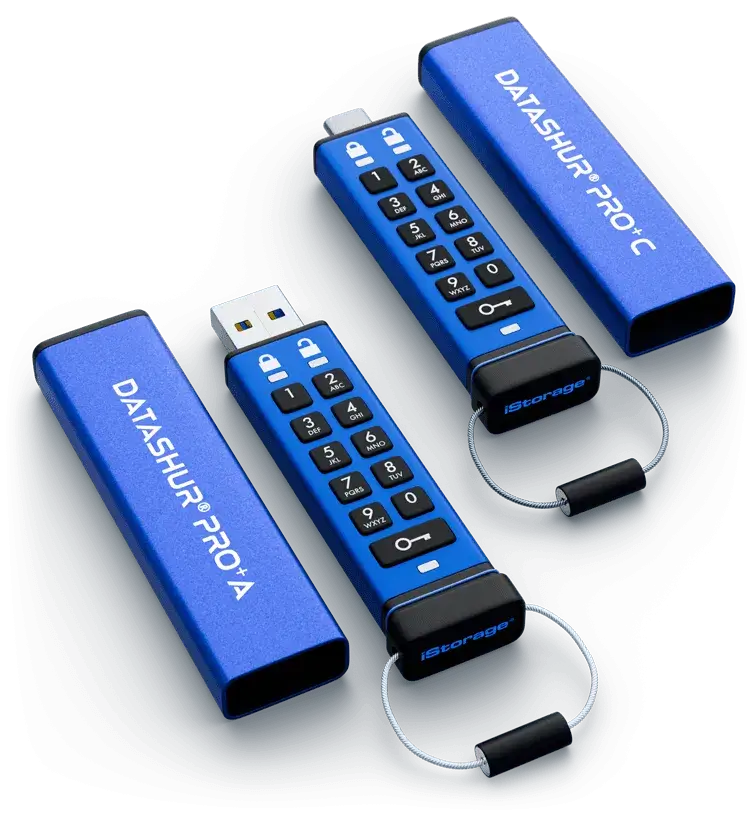
iStorage datAshur PRO2
USB-A · USB 3.2 · up to 128 GB
The datAshur PRO2 is the benchmark of the category. Its Common Criteria EAL5+ certified microprocessor goes further than most competitors — it includes hardware-level protection against SPA, DPA, SEMA, and DEMA side-channel attacks, plus an Active Shield layer that detects and responds to physical probing.
All internal components are encapsulated in epoxy resin. The aluminum casing is robust and the PIN keypad is polymer-coated to mask which buttons are most frequently used. NATO Restricted certification makes it one of the few drives cleared for defence and government work across NATO member states.
The drive works entirely without software on any OS, including embedded systems, medical equipment, and thin clients. Auto-lock on USB removal, read-only mode, and a self-destruct PIN are all available.
Kingston IronKey Keypad 200
USB-A / USB-C · USB 3.2 · 16 GB – 512 GB
The KP200 holds the current highest certification available on a commercial USB flash drive: FIPS 140-3 Level 3 — the 2020 generation standard that superseded FIPS 140-2 with enhanced random number generation, periodic self-tests, and stronger tamper-response requirements.
The alphanumeric keypad (letters + numbers) allows for longer, more complex PINs than numeric-only keypads. The entire keypad is polymer-coated to prevent fingerprint analysis. Epoxy-sealed circuitry makes chip extraction physically destructive.
Available in USB-A (16–32 GB) and USB-C (64–512 GB) models — the USB-C variant reaches read speeds up to 280 MB/s and write speeds up to 200 MB/s, making it among the fastest in this category.
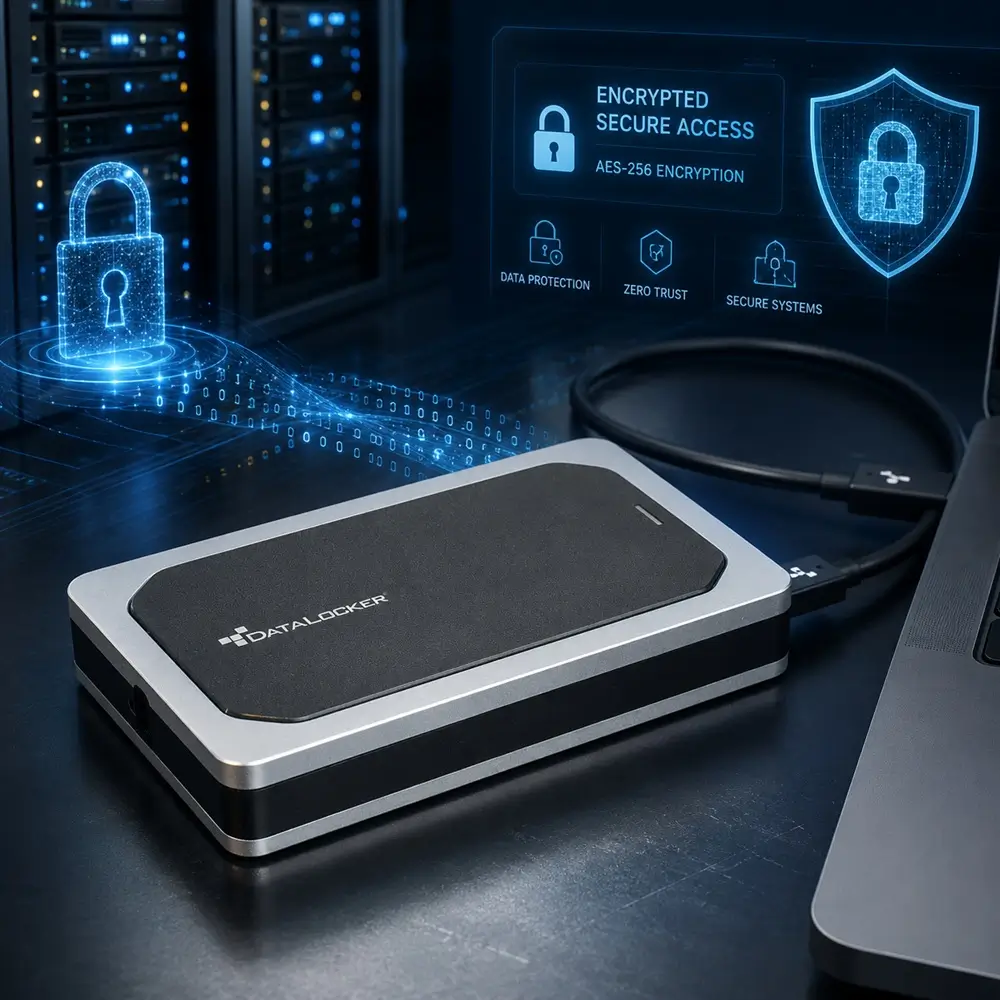
DataLocker Sentry K350
USB-A · USB 3.2 · up to 128 GB
The K350 is the most user-friendly high-security drive on this list. Its integrated OLED display shows clear prompts during password entry and lock/unlock — eliminating the guesswork of LED-only status indicators. It supports full alphanumeric passwords (letters + numbers + symbols), making brute-force attacks computationally implausible.
SilentKill is a unique feature: a specific password combination triggers an immediate, silent crypto-erase with no visible indication — designed for high-pressure situations where coercion is a risk.
The K350 works as a standalone drive or integrates with DataLocker SafeConsole for enterprise-level fleet management, remote wipe, geofencing, and audit reporting. Durable aluminium housing with MIL-STD-810F vibration and impact certification.
DataLocker DL GO
USB-A (USB-C adapter included) · USB 3.2 · 4 – 64 GB
The DL GO is the drive for users who need strong encryption without friction. Unlock is handled entirely through the host machine's biometrics — Windows Hello on PCs, Touch ID on Macs — meaning no PIN to memorize and no keypad to operate. For higher-assurance environments, biometrics and PIN can be combined as two-factor authentication.
IP68 waterproofing, an epoxy-filled metal housing, and a 5-year warranty round out the physical durability. SafeConsole integration supports enterprise fleet management when needed.
Note: FIPS 197 (not 140-2 Level 3) makes this the right choice for compliance-aware teams where convenience matters, but not for environments requiring Level 3 tamper-evidence. Read the full launch article in our DataLocker DL GO review.
Kanguru Defender 3000
USB-A · USB 3.2 · up to 256 GB
The Defender 3000 is unique in this comparison: it includes on-board BitDefender antivirus that scans files in real time as they are read or written. This prevents the drive from becoming a malware vector when used across multiple machines — a common attack surface in enterprise environments.
The integrated USBtoCloud feature enables automatic encrypted backup directly to cloud storage (Google Drive, OneDrive, Dropbox, Amazon S3) without additional software. Self-service password reset lets users recover access independently without IT involvement, reducing helpdesk load at scale.
The Kanguru Remote Management Console (KRMC) provides centralized control comparable to SafeConsole: remote wipe, policy enforcement, audit trails, and geographic restrictions. TAA compliance makes it eligible for U.S. government procurement.
Which Drive for Which Scenario
Government / Defence
Requires NATO Restricted or FIPS 140-2/3 Level 3. On-device authentication, no host dependencies.
Highest Certification Required
Organisations whose procurement specifies FIPS 140-3 Level 3 — the current NIST standard post-2020.
Enterprise Fleet (IT-managed)
Large rollout needing centralized management, remote wipe, audit trails, and complex password policies.
Compliance without Friction
Teams where GDPR/HIPAA compliance is required but users need a simple, fast unlock experience.
Shared / Multi-machine Use
Drive used across many untrusted PCs. Built-in antivirus prevents the drive becoming a malware carrier.
High Capacity + Speed
Large files, video, or database backups requiring maximum USB-C throughput at the highest security level.
Quick Comparison Table
| Drive | Certification | Authentication | Management | Best for |
|---|---|---|---|---|
| datAshur PRO2 | FIPS 140-2 L3 | PIN keypad | Standalone | Gov / Defence |
| IronKey KP200 | FIPS 140-3 L3 | Alphanumeric keypad | Standalone | Highest cert |
| DataLocker K350 | FIPS 140-2 L3 | OLED + alphanumeric | SafeConsole | Enterprise IT |
| DataLocker DL GO | FIPS 197 | Windows Hello / Touch ID | SafeConsole | Ease of use |
| Kanguru Def. 3000 | FIPS 140-2 L3 | Software password | KRMC | Antivirus + cloud |
A Note on FIPS Certification Levels
All five drives use AES-256 XTS hardware encryption. The differences in FIPS level reflect the depth of independent testing — not just the encryption algorithm itself. FIPS 140-3 Level 3 (IronKey KP200) represents the current generation standard, while FIPS 140-2 Level 3 (datAshur PRO2, K350, Defender 3000) remains fully valid and is required by most government frameworks in force today. FIPS 197 (DL GO) confirms correct AES implementation but does not include the physical tamper-evidence or identity-based authentication requirements of Level 3.
For a deep dive into how FIPS 140-3 Level 3 applies in practice on a specific model, see our detailed article on the Kingston IronKey Keypad 200 FIPS certification.
Dataway Security is an authorised EU distributor for iStorage, Kingston IronKey, DataLocker, and Kanguru. All products ship to 26 EU countries within 3–6 business days. For volume orders or compliance-specific questions, request a quote.
Browse all encrypted USB drives →Same category
- How to Choose and Test a Professional Faraday Tent.
- Understanding FIPS 140-2 Standards for Secure Data Storage
- Overview of the Mission Darkness BlockBox Lab XL Forensic Enclosure
- Why Hardware Encrypted USB Drives Outperform Software Solutions
- The Digital Shield: Understanding the Importance of Faraday Bags